

 Ru
Ru En
En

Scaffolding was actively used in Old Russian architecture. Up until the mid 20th century, scaffolding was made of wood.
The attachment of scaffolding to the walls of the structure was similar to the technique used in Western countries. Wooden timber was placed in the masonry wall when it was built. When construction was completed, the protruding part of the timber was cut or sawn off. Then the wood rotted away leaving holes in the masonry wall. The shape and diameter of these holes suggest that scaffolding at that time consisted mainly of round timber. Such holes with remnants of wood have been found in a number of ancient structures. During finishing the holes were closed with plaster and covered with painting.
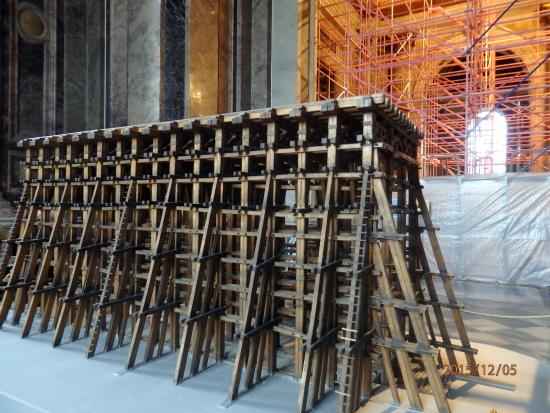
There were two types of scaffolding. In the first type, the wooden timber went through the wall. Scaffolding decking was supported by horizontal beams inserted into the wall. A similar structure was found in the Chernigov Cathedral of the Eletsky Monastery, as well as in Smolensk monuments of the mid XII century.
In another type of scaffolding, the timber was buried in the wall only 15-20 cm, sometimes 40 cm, rather than going all the way through the wall. Obviously, with this scaffolding design, the horizontal beams were insufficient support for the decking, so additional vertical poles were introduced in the form of large logs.
It should be noted that the results of archaeological research do not allow us to fully judge the complexity of the scaffolding design of that time. For example, the technique of lifting fired bricks and mortar to the top is still unknown. Excavations in Veliky Novgorod indicate that liquid materials were lifted in wooden buckets with the help of a primitive wooden pulley. The scaffolding must have been equipped with special ladders, which were used to lift the handlers with bricks and stones in special ‘sacks’.
As early as in the XI - XII centuries Russian architecture was so developed and architectural projects so complex that required a separate scaffolder occupation. We learn from late 16th century sources that at that time scaffolding was called ‘strapping’ and the workers who set it up were called ‘strappers’.
Holes on the inner and outer surfaces of the walls of the structure suggest that such scaffolding was double-sided, allowing bricks to be laid on both surfaces simultaneously. Consequently, the masonry process was a synchronized work of pairs of masons.
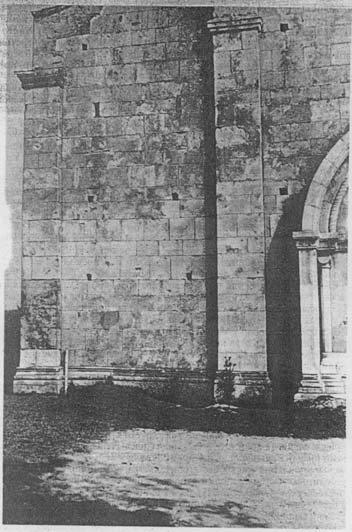
The researchers calculated that a single mason made approximately seven rows of masonry in one day, which roughly corresponds to 0.88 m3. Each mason laid only half of the wall thickness, which is evidenced by the presence of grooves from the timbers on both surfaces of the wall at the same height. It is interesting to note that when this labor productivity rate is compared with similar nineteenth-century rates, it turns out to be only one and a half times lower than that of later masters.
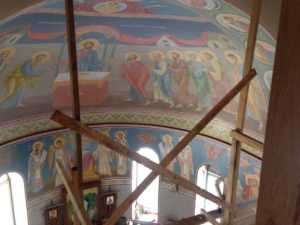
The scaffolding was not dismantled for another year or so after the building was completed. This was due to two factors. Firstly, the masonry had to dry out. Secondly, this scaffolding was used to cover the structure with a special mortar on the outside and to apply murals on the inside.
It was the painting that set the pace and order of scaffolding dismantling. Lastly, after dismantling the scaffolding supports, the room was floored. It is interesting to note that the galleries and aisles were built after dismantling the external scaffolding.
So, scaffolding was widely used in Ancient and Medieval Russia. The magnificent temples of Veliky Novgorod, Smolensk, Kiev and Halych testify to the active use of scaffolding methods, as well as to the high level of development of construction technology of that time.

Our expert will contact you soon