

 Ru
Ru En
En
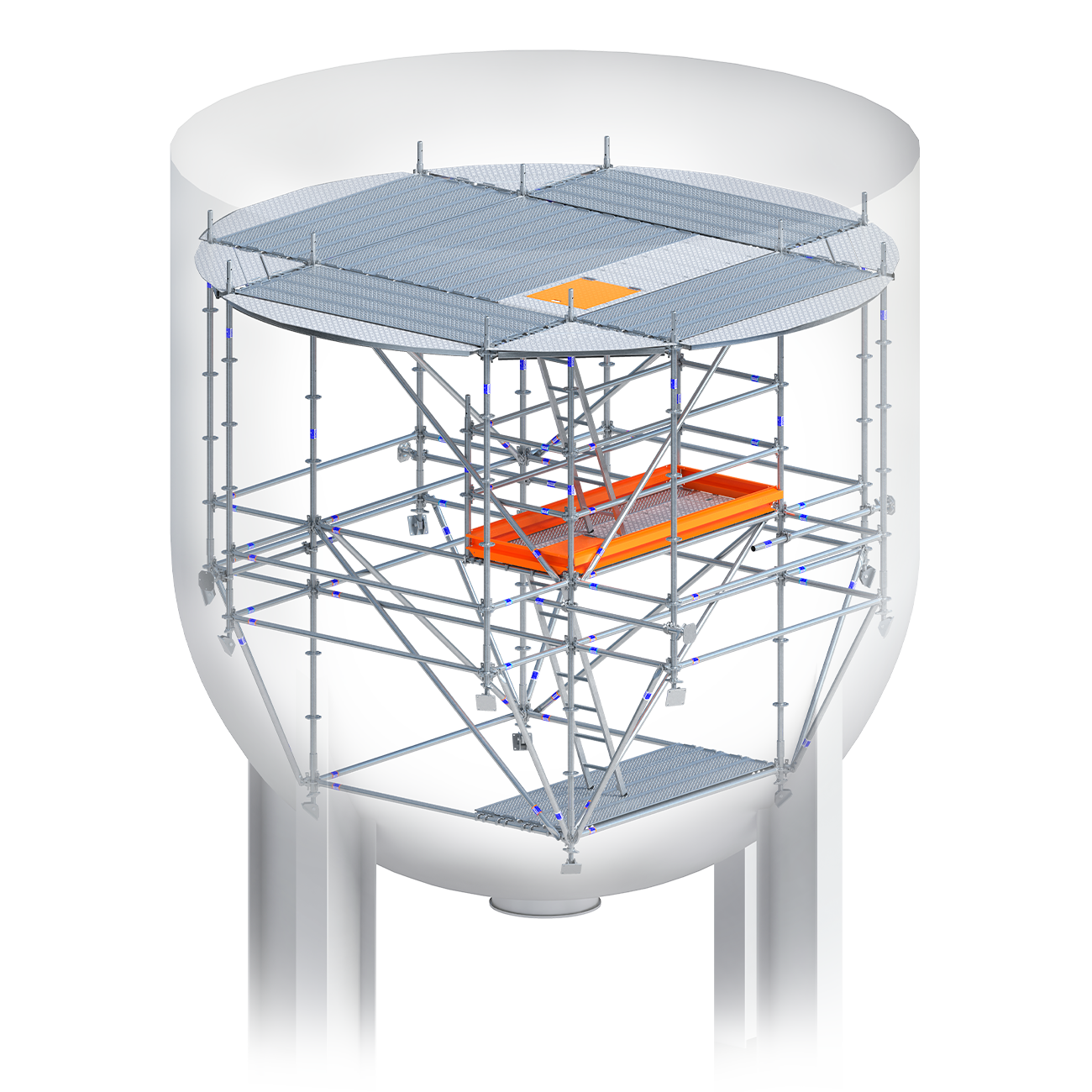
Sometimes, in different cases of scaffolding application, there are slanting surfaces on which scaffolding frames must be installed.
As a rule, base plate screw jacks with a hinged heel are used for this purpose. Thanks to the hinge joint, the heel automatically assumes the angle of inclination of the surface on which the scaffolding is installed.
It is worth remembering that scaffolding on an inclined surface is prone to slipping. In order to operate the scaffolding safely, it is necessary to securely fasten the support heels to the surface and/or loosen them together as close as possible to the point of support on the inclined surface. The release will remove unnecessary bending moments in the support elements.
Scaffolding can also be installed on symmetrical/mirrored inclined surfaces located opposite each other, for example, on inclined hearths of boilers, which can have various shapes (hemisphere, inverted pyramid or cone, and others). In such cases, the forces causing slippage balance each other due to the expansion of the structure between the supporting surface and other points (for example, the walls of the boiler).
When the scaffolding is symmetrically spaced on inclined surfaces, significant compressive forces occur in the horizontal elements of the zero scaffolding; in such cases, they should be carefully checked for loss of stability.
Technical data
|
Span length / width |
0.25–7 m |
|
Structure height |
100 m (calculation and design is required) |
|
Load |
200, 300, 450, 600 kg/m2 per working level |
|
Maximum inclination angle |
85° |
We are ready to answer all your questions, call us or leave a number and we will call you back.

Our expert will contact you soon